REWIRE
Habits & mindset
Understand the patterns that make it difficult to start, stay consistent or recover after a setback.
FOR JEE & NEET · CLASS XI, XII & DROPPERS
Your marks tell you what happened. We help uncover why — then turn focus, revision, accuracy and exam strategy into a measurable plan.
Start with your preparation. See what needs a closer look.
One problem. A clearer next step.
Start with study initiation and interruptions.
Completed focus blocks
An example of the approach. Your audit and test history guide your own plan.
Explore the part of CNM that matters to you.
Understand where you get stuck. See how planning, practice and test review fit into your preparation.
Explore student support →02 / PARENTSLook beyond the score. Know what to ask, what progress to review and what to clarify before enrolment.
Explore the parent guide →03 / PARTNERSFor schools, coaching teams, educators and collaborators exploring better support for students.
Explore a collaboration →A concept gap needs a different response from a revision gap. So does rushing a question, avoiding a mock or struggling to start.
Use your audit answers, recent tests and study routine to identify what needs a closer look.
Set a priority. Match the learning, practice or study habit to the problem you are working on.
Compare planned work with completed work. Revisit recurring mistakes and adapt the next week.
Explore a guided preview based on CNM’s current dashboard tools, from a reviewed mistake to a Daily Mission and the next progress review.
A plan, a focused session, a useful review. Tools should make the next action clearer.
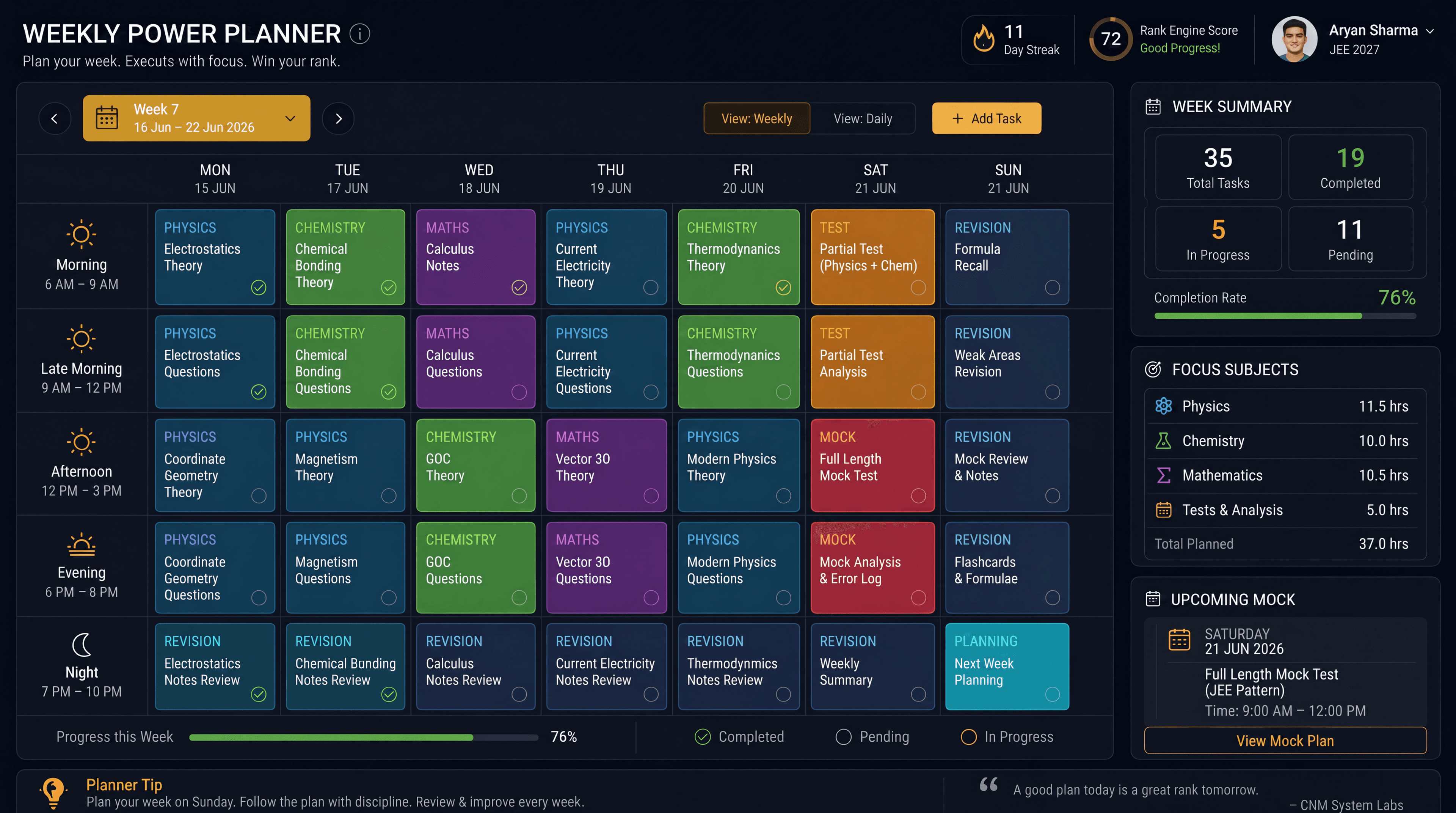
Make the week realistic. Give your revision, practice and tests a place in it.
These areas work together. The right starting point depends on the student; everyone does not need the same intervention.
Understand the patterns that make it difficult to start, stay consistent or recover after a setback.
Turn priorities into a realistic week, focused study blocks and a review of completed work.
Reconnect ideas and strengthen the understanding behind the formulas and solutions.
Use targeted practice and recall to revisit what needs strengthening.
Work on the habits and test strategies that support calmer exam execution.
A useful conversation goes beyond ‘How many hours?’ or ‘How many marks?’ Look at the work, the difficulty and the next change together.
Includes the questions to ask before choosing a programme.
Explore a focused pilot or a collaboration in learning, practice or student support. Begin with the students you serve and the problem you want to solve.
Before you choose support, ask to see how it will work in your situation.
Explore the tools and the reasoning. Interface previews and illustrative examples are labelled as examples.
Clarify the modules, duration, support, review arrangements and total fees before enrolment.
Check consistency, recall and repeated errors over time. Specific scores, ranks and admissions are not guaranteed.
See how CNM’s tools can support a more specific response to familiar preparation difficulties.
A student understands the chapter but keeps losing marks on signs, units or question constraints.
What to review next: Try new questions under comparable time limits. Check whether the same sign and unit errors recur, rather than only re-solving familiar questions.
Explore this scenario →New chapters keep getting attention while previously studied concepts become harder to recall.
What to review next: Try recalling the concept later without notes. Record what was recalled and what still needs another review; a checked task is not proof of retention.
Explore this scenario →A student plans more work than fits around classes and keeps carrying unfinished tasks into the next day.
What to review next: Compare planned and completed tasks, recorded study and test evidence. Use Progress Radar to inspect recorded activity across complete review periods, and resize the next plan.
Explore this scenario →Illustrative situations, not student case histories, testimonials or measured CNM outcomes. They explain the approach; they do not predict a student’s result.
Understand the approach, the fit and the next step.
CNM brings together concept learning, performance review, planning and study habits for JEE and NEET preparation. The starting question is where your current preparation is getting stuck, so the next action can be more specific than ‘study harder’.
It can be. Your classes may cover the syllabus while you still need help with revision, consistency, test review or exam execution. Discuss your current routine with CNM before choosing support so the two fit together.
The audit asks about your preparation and study habits. Treat the answers as a starting point to discuss, alongside recent tests and examples of your work. A self-report alone cannot establish the exact cause of a low score.
No. Results depend on your starting point, preparation, exam conditions and follow-through. Review changes in your work and test performance over time; a target is not a guaranteed outcome.
See the Programmes & fees page for the fee guide. Ask CNM to confirm the selected modules, access duration, support, review frequency, tax treatment and final payable amount in writing before enrolment.
Begin with your preparation, not a preselected package.
The audit is a starting point for a better conversation about your focus, revision, test habits and execution.
See what to expect before opening the assessment. Parents and partners can contact CNM directly.